Casa Igor began as a small, character-filled restaurant run by a seasoned local entrepreneur ready to move on to his next venture. In early 2025, I teamed up with my long-time friends Sebastian and Luna to acquire and revitalise the space.
With my background in retail, commercial, and operations, along with Seba’s people-first approach and Luna's marketing and branding expertise, we recognized the opportunity to revitalize and grow a beloved neighborhood spot.
The plan was simple: buy an existing business with solid bones and profitable operations, reorganise its structure, and grow it into a higher-margin, community-driven restaurant that combined great food, drinks, and a modern sense of hospitality.
the model
The Problem: Casa Igor wasn’t realising its potential.
When we stepped in and looked into the numbers, Casa Igor wasn’t realising its potential. It was open only a few days a week, had no cocktail menu, no delivery service, and minimal marketing.
Management had lost interest, and the business was running on autopilot; surviving on a loyal local base but missing the enormous tourist flow that defines Barcelona’s restaurant scene.
Margins were thin, revenue was inconsistent, and the brand was invisible online.
Our business-first approach
Our approach was to treat Casa Igor not just as a restaurant, but as a holistic business model.
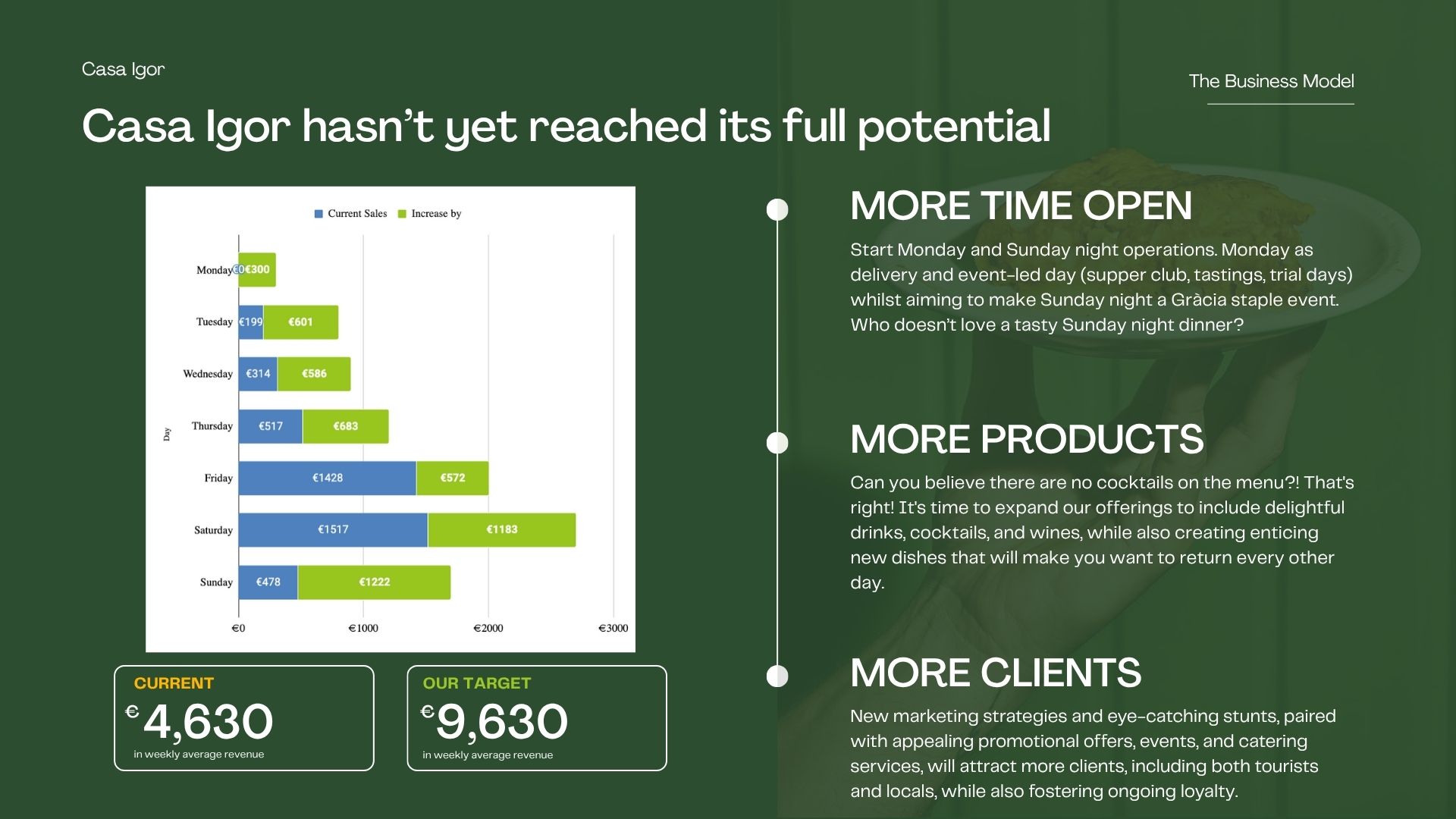
We identified three key levers for growth:
More time open — adding Sundays and Mondays, turning low-traffic days into themed experiences like “Monday Supper Club” or “Sunday Sessions.”
More products — introducing cocktails, wines, and desserts with margins of 70 to 220%, balancing the low-margin food offering.
More clients — repositioning Casa Igor for both locals and tourists through better branding, digital presence, and events.
The aim was to transform a traditional tapas bar into a hybrid hospitality business with dine-in, delivery, events, and retail components.
The Business Model
Casa Igor was structured around four revenue pillars:
Dine-in sales — core revenue driver, improved through better pricing and menu engineering.
Delivery & Takeaway — tapping into new channels via local platforms.
Retail & Merchandise — small-batch sauces, wines, and branded products.
The projected model aimed for:
Annual Revenue: €450 – €510 k
Gross Margin: ≈ 70%
EBITDA Margin: ≈ 32%
Net Profit Margin: ≈ 27%
All while maintaining a lean, motivated team and a clear sense of place in the Gràcia community.
Financial Framework
The acquisition required a total investment of €85k for purchase and €50k in operational financing, partly funded through a structured loan with a 20-month repayment horizon.
Key assumptions:
Revenue uplift: +110% YoY after menu, hours, and marketing changes.
Gross profit: ~65–70% driven by cocktails and events.
Net profit: €130k+ achievable by year 2.
Break-even: Within 10–12 months.
The model struck a balance between realism and scalability, proving that small restaurants, if data-driven and operationally efficient, can achieve investor-level returns.